
The Institute of Mindful Medicine was created to help clinicians build thoughtful, whole-person practices that integrate functional medicine, ketamine therapy, neuroplasticity, lifestyle medicine, and practical clinical systems.
IMM was built on the belief that ketamine should not be viewed as a stand-alone treatment. Meaningful change is more likely to be supported when the neuroplastic window created by ketamine is paired with attention to physiology, lifestyle, nervous-system regulation, environment, relationships, and ongoing integration.
Rather than focusing only on symptoms or diagnosis, the Mindful Medicine model looks at the whole person—creating the conditions that can help patients translate a temporary neuroplastic opportunity into more durable changes in how they think, feel, and live.
To create a network of thoughtful, clinically grounded practices that bring the principles of Mindful Medicine into communities across the country.
To train and support clinicians with practical education, clinical frameworks, and implementation systems that elevate whole-person patient care.
Many clinicians have access to therapies, but lack a cohesive framework to apply them effectively. The Institute of Mindful Medicine was created to provide structure, systems, and clinical clarity that support consistent, long-term outcomes.
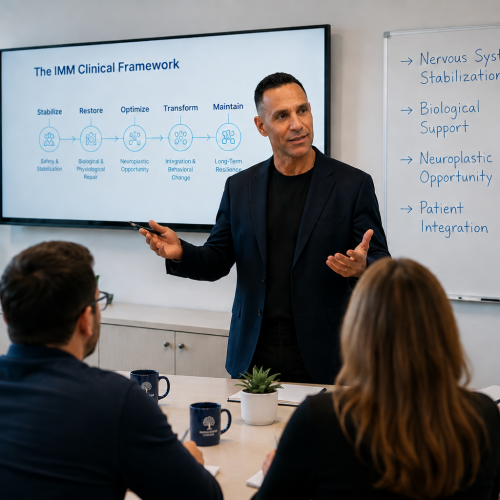
Many clinicians have access to therapies but lack a structured model for determining how and when they fit into patient care.
Protocols provide a starting point. Consistent outcomes also require clinical judgment, patient selection, monitoring, and thoughtful implementation.
Successful programs require clear workflows, boundaries, communication, documentation, and systems that support both patients and providers.
IMM was built to help clinicians move beyond education and translate what they learn into sustainable real-world practice.
IMM began as an immersive training experience designed to bring clinicians inside a working integrative medical practice—not simply into a classroom.
Participants could see how clinical decision-making, functional medicine, ketamine therapy, patient experience, workflows, staffing, and implementation come together in everyday practice.
That original vision remains at the heart of IMM today. The long-term goal is to support clinicians who want to carry these principles into their own practices and build programs grounded in the same thoughtful, whole-person approach.
Understand the philosophy, clinical frameworks, treatment environment, and systems behind the practice.
Adapt what you learn to your patients, team, services, and clinical setting.
Eligible practices may continue growing through clinical resources, sensory playlists, marketing tools, ongoing education, and connection to the broader IMM community.
For eligible practices, IMM Membership provides ongoing resources and support designed to help bring the model into daily clinical practice. Members gain access to exclusive sensory playlists, clinical and marketing resources, ongoing Q&A, implementation tools, technology guidance, and future opportunities for IMM Center visibility.
Dr. Brent Agin developed the concept of Neuroexpression to describe the brain’s ability to express new patterns of thought, emotion, behavior, and healing when physiology, neuroplasticity, environment, and clinical support are appropriately aligned.
Neuroexpression begins with physiological safety. Patients often struggle to create lasting change when the nervous system remains chronically dysregulated.
Ketamine-assisted neuroplasticity may create temporary windows where new emotional, cognitive, and behavioral patterns become more accessible.
Long-term transformation requires structure, reflection, and real-world implementation that helps patients sustain meaningful change over time.
Brent Agin, MD, is a physician in functional and regenerative medicine with more than 20 years of clinical experience and more than 5,000 personally administered ketamine treatments.
Throughout his career, Dr. Agin has focused on the intersection of physiology, lifestyle, neuroplasticity, patient experience, and emerging therapies. His clinical work led to the development of the Mindful Medicine model and ultimately the Institute of Mindful Medicine.
Through IMM, Dr. Agin brings together real-world clinical experience, systems-based medicine, and practical provider education with the goal of helping clinicians build thoughtful, sustainable practices—not simply learn another protocol.
Explore training options designed for different stages of your practice—from self-paced ketamine education to immersive, hands-on clinical training.